
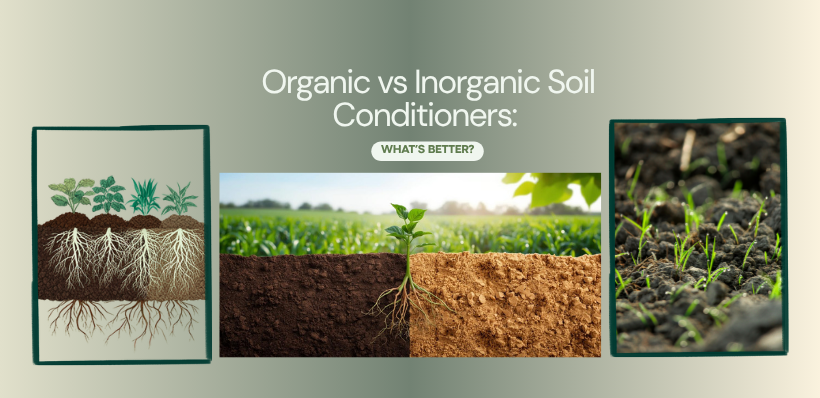
Organic vs Inorganic Soil Conditioners: Which Is Better for Sustainable Farming?
Organic vs inorganic soil conditioners play a crucial role in improving soil health and crop productivity. Understanding the difference between these soil conditioning methods helps farmers choose the best approach for sustainable agriculture and long-term soil fertility.Soil is the foundation of agriculture. Its quality directly impacts plant growth, crop yield, and long-term farm profitability. Healthy soil supports root development, enhances nutrient absorption, and improves water retention capacity. However, in many agricultural regions, soil health has declined due to excessive chemical use, monocropping, and improper land management practices. Over time, these practices lead to soil degradation, reduced organic matter, poor structure, and loss of beneficial microorganisms. As a result, farmers face declining yields and increasing dependency on external inputs.To overcome these challenges, soil conditioners are widely used to restore soil balance. Many farmers are now shifting toward natural farming soil conditioners that improve soil health without harming the environment. Organic soil conditioners are better for long-term soil health because they improve soil structure, microbial activity, and sustainability, while inorganic soil conditioners provide quick but temporary improvements.
What Are Soil Conditioners?
Soil conditioners are substances added to soil to improve its physical, chemical, and biological properties. They play a vital role in modern agriculture by enhancing soil structure, increasing water retention, and improving aeration.These inputs are especially useful in degraded soils where productivity has declined. By improving soil conditions, they create a better environment for plant roots, leading to healthier crops and higher yields.
Soil conditioners can be broadly classified into two categories:
- Organic soil conditioners
- Inorganic soil conditioners
Both serve different purposes and are used based on soil type, crop requirements, and farming goals.
Organic Soil Conditioners
Organic soil conditioners are derived from natural sources such as plant residues, compost, animal manure, and green manure. These inputs improve soil fertility by increasing organic matter and promoting beneficial microbial activity.
Organic inputs are widely recognized as soil fertility boosters organic because they enhance soil ecosystems and support sustainable agriculture.
Key Benefits of Organic Soil Conditioners
- Improves Soil Structure
Organic matter binds soil particles together, creating a stable structure that allows better root growth. - Enhances Microbial Activity
Beneficial microorganisms break down organic matter and release nutrients in a plant-available form. - Improves Water Retention
Organic soils retain moisture better, reducing irrigation needs. - Supports Long-Term Fertility
Unlike chemical inputs, organic conditioners build soil health over time. - Eco-Friendly Solution
They reduce environmental impact and support biodiversity.
Farmers use these inputs as organic crop yield boosters because they improve plant health and increase productivity naturally.
Inorganic Soil Conditioners
Inorganic soil conditioners are synthetic or mineral-based materials used to modify soil properties quickly. Common examples include gypsum, lime, and chemical amendments.
These conditioners are particularly useful when immediate soil correction is required.
Benefits of Inorganic Soil Conditioners
- Quick Results
They act rapidly to correct soil problems such as pH imbalance. - Targeted Application
Useful for addressing specific soil deficiencies. - Improved Soil Chemistry
Help in adjusting nutrient availability and chemical balance.
Limitations
- Do not improve soil biology
- Limited long-term benefits
- Overuse can lead to soil degradation
Key Differences Between Organic and Inorganic Soil Conditioners
1. Soil Health
Organic conditioners improve biological activity and long-term soil fertility.
Inorganic conditioners mainly adjust physical or chemical properties.
2. Nutrient Release
Organic inputs release nutrients slowly and consistently.
Inorganic inputs provide immediate nutrient availability.
3. Environmental Impact
Organic conditioners are environmentally friendly and sustainable.
Inorganic conditioners may cause pollution if misused.
4. Sustainability
Organic solutions support long-term farming systems.
Inorganic solutions are short-term fixes.
Role of Soil Fertility in Crop Productivity
Soil fertility is one of the most critical factors affecting crop yield. Fertile soil ensures that plants receive essential nutrients required for growth.
Farmers are increasingly adopting soil fertility boosters organic to improve soil quality naturally. These inputs enhance nutrient availability and improve plant resistance to stress conditions such as drought and pests.
Healthy soil leads to:
- Better root development
- Higher nutrient absorption
- Improved crop resilience
- Increased yield
How Organic Conditioners Improve Soil Health
Organic soil conditioners improve soil health through natural biological processes.
- Increase Organic Matter
Organic matter improves soil structure and nutrient retention.
- Boost Microbial Activity
Microorganisms break down organic material and release nutrients.
- Improve Aeration
Loose soil structure allows roots to grow freely.
- Enhance Water Retention
Organic matter acts like a sponge, holding moisture in the soil.These benefits make organic inputs highly effective organic crop yield boosters for long-term agricultural success.
When Should Farmers Use Inorganic Soil Conditioners?
Inorganic soil conditioners are useful in specific situations:
- When soil pH needs immediate correction
- When drainage issues need to be addressed
- When there is a sudden nutrient deficiency
However, they should be used carefully and ideally combined with organic practices.
Integrated Approach: Best of Both Worlds
The most effective farming strategy is often a combination of organic and inorganic soil conditioners.
Why Integration Works
- Organic inputs build long-term soil health
- Inorganic inputs provide quick correction
- Balanced approach improves productivity and sustainability
Farmers using natural farming soil conditioners along with controlled inorganic inputs can achieve optimal results.
Long-Term Benefits of Organic Soil Conditioners
Organic soil conditioners offer several advantages that make them ideal for sustainable farming:
- Improved soil fertility
- Increased microbial activity
- Better water retention
- Reduced dependency on chemicals
- Enhanced crop productivity
This is why soil fertility boosters organic are becoming essential in modern agriculture.Farmers across India, especially in states like Maharashtra and Karnataka, have reported significant improvements after adopting organic soil practices.
Observed Results:
- Increased crop yield over time
- Reduced input costs
- Improved soil texture
- Better drought resistance
These real-world outcomes highlight the importance of organic soil management in sustainable agriculture.
Statistics and Trends
- Organic farming is growing rapidly worldwide
- Demand for chemical-free food is increasing
- Governments are promoting sustainable agriculture
- Farmers are reducing dependency on chemical inputs
These trends indicate a strong shift toward eco-friendly farming practices.
Organic vs Inorganic Soil Conditioners (Comparison Table)
Factor | Organic Conditioners | Inorganic Conditioners |
Source | Natural | Synthetic |
Nutrient Release | Slow | Fast |
Soil Health | Improves | Limited |
Environmental Impact | Low | Higher |
Sustainability | High | Moderate |
Conclusion
Choosing between organic vs inorganic soil conditioners depends on the farmer’s goals and soil conditions.
- Inorganic conditioners provide quick solutions
- Organic conditioners offer long-term benefits
For sustainable farming and consistent productivity, organic inputs are the better choice. Farmers using soil fertility boosters organic and natural farming soil conditioners can improve soil health, increase yields, and build resilient agricultural systems. In the long run, sustainable soil management is essential for food security and environmental protection.
FAQs
- What are organic soil conditioners?
- Organic soil conditioners are natural materials that improve soil fertility, structure, and microbial activity.
- What are inorganic soil conditioners?
- Inorganic soil conditioners are synthetic inputs used for quick soil improvement.
- Which is better for soil health?
- Organic soil conditioners are better for long-term soil health.
- Do organic conditioners increase crop yield?
- Yes, they improve soil fertility and enhance plant growth.
- Are inorganic conditioners harmful?
- They are safe if used properly but may harm soil over time if overused.
- What are soil fertility boosters organic?
- They are natural inputs that improve soil nutrients and microbial activity.
- Can both types be used together?
- Yes, combining both can provide balanced results.
- Why is soil health important?
- Healthy soil ensures better crop productivity and sustainability.
- What is the future of soil management?
- Sustainable practices using organic inputs are the future of agriculture.
Not Sure Which Product Is Right for Your Crop?
Our agriculture experts are ready to help you choose the best organic solution.