
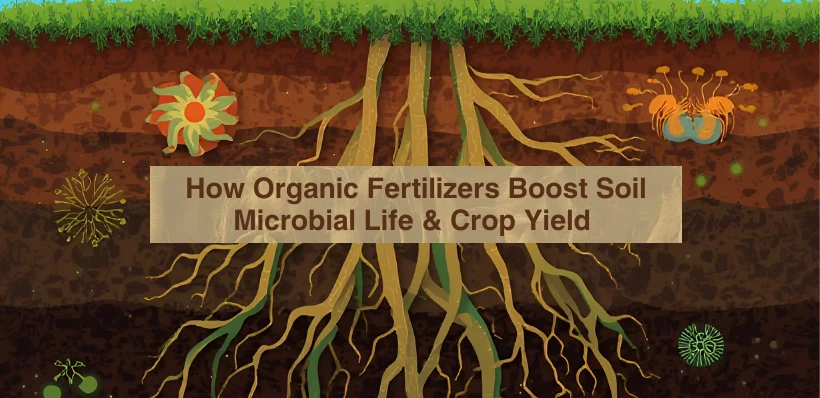
How Organic Fertilizers Boost Soil Microbial Life & Crop Yield
Soil is not just a growing medium – it is a living ecosystem. Beneath every healthy crop lies a thriving community of microorganisms working silently to break down organic matter, cycle nutrients, and protect plant roots. When this microbial life is strong, crops flourish. When it is weak, productivity declines.
This is exactly how organic fertilizers boost soil microbial life & crop yield -by feeding the biology of the soil instead of only supplying chemical nutrients.
Unlike synthetic fertilizers that focus mainly on NPK (Nitrogen, Phosphorus, Potassium), organic fertilizers nourish the soil ecosystem itself. They stimulate microbial growth, improve soil structure, enhance water retention, and create a long-term foundation for sustainable crop yield.
Understanding Soil Microbial Life
Healthy soil contains billions of living organisms per teaspoon. These include:
- Bacteria
- Fungi
- Actinomycetes
- Protozoa
- Nematodes
- Earthworms
Together, they form a complex soil food web. Each organism plays a specific role in breaking down organic material and converting nutrients into plant-available forms.
Why Microbial Diversity Matters
A diverse microbial population ensures:
- Balanced nutrient availability
- Disease suppression
- Efficient decomposition
- Stronger plant immunity
- Better root development
- Improved soil structure
Without microbes, even the best fertilizers cannot deliver nutrients effectively to plants. Nutrients locked in soil particles remain unavailable without biological activity.
Why Soil Microbes Are the Real Drivers of Crop Yield
Many farmers focus only on NPK levels. However, nutrients must first be converted into absorbable forms before roots can take them up. Microbes perform this conversion process.
Key Microbial Functions That Increase Yield
- Nitrogen Fixation
Certain bacteria convert atmospheric nitrogen into usable forms. This naturally reduces dependency on synthetic nitrogen fertilizers.
- Phosphorus Solubilization
Microorganisms release organic acids that unlock bound phosphorus in soil.
- Decomposition of Organic Matter
Crop residues and compost are broken down into humus, enriching soil fertility.
- Production of Plant Growth Hormones
Some microbes produce auxins and gibberellins that stimulate root and shoot growth.
- Improvement of Soil Structure
Fungal networks bind soil particles, improving aeration and root penetration.
When microbial life is abundant, crops receive nutrients more efficiently, resulting in stronger growth and higher productivity.
What Are Organic Fertilizers?
Organic fertilizers are natural inputs derived from plant, microbial, and animal sources. Examples include:
- Compost
- Vermicompost
- Farmyard manure
- Green manure
- Biofertilizers
- Seaweed extracts
- Fermented organic solutions
Unlike chemical fertilizers, organic fertilizers:
- Release nutrients slowly
- Improve soil organic carbon
- Increase microbial biomass
- Enhance water retention
- Improve soil aggregation
- Build long-term soil fertility
They do not simply feed the plant — they feed the soil ecosystem.
How Organic Fertilizers Boost Soil Microbial Life & Crop Yield
1. They Provide Carbon – The Energy Source for Microbes
Microorganisms require carbon as food. Organic fertilizers contain complex organic compounds that serve as a steady energy source.
When compost or bio-organic inputs are added:
- Microbial respiration increases
- Enzyme production rises
- Nutrient transformation accelerates
- Soil biological activity improves
This creates a biologically active soil environment that enhances nutrient availability.
2. They Increase Soil Organic Matter (SOM)
Soil organic matter is essential for sustaining microbial communities.
Higher SOM leads to:
- Improved microbial diversity
- Enhanced moisture retention
- Greater nutrient-holding capacity
- Reduced soil erosion
- Improved root penetration
Over time, this improves overall soil fertility and agricultural productivity.
3. They Encourage Beneficial Fungi
Mycorrhizal fungi form symbiotic relationships with plant roots. These fungi extend the root system’s reach, helping plants absorb more nutrients and water.
Organic farming systems promote fungal growth because they:
- Avoid harsh chemical salts
- Provide organic substrates
- Maintain soil biological balance
In chemical-heavy soils, fungal networks often decline, reducing nutrient efficiency.
4. They Support Nitrogen-Fixing Bacteria
Nitrogen-fixing bacteria convert atmospheric nitrogen into ammonia.
Organic fertilizers:
- Improve soil habitat conditions
- Support root nodulation
- Increase nitrogen availability naturally
- Reduce input costs
This directly contributes to higher crop yield naturally.
5. They Enhance Phosphorus Availability
Phosphorus is often locked in insoluble forms.
Organic fertilizers stimulate:
- Phosphate-solubilizing bacteria
- Organic acid production
- Better root expansion
- Higher flowering potential
This is especially critical for fruiting crops like grapes, pomegranate, and mango.
Here is how microbial activity translates into measurable agricultural results:
Farmers using organic fertilizers consistently report:
- Better crop uniformity
- Improved grain filling
- Increased fruit size
- Enhanced sweetness and taste
- Improved shelf life
- Higher market value
This clearly demonstrates how organic fertilizers boost soil microbial life & crop yield in practical field conditions.
Organic vs Chemical Fertilizers: Long-Term Effects
Factor | Organic Fertilizers | Chemical Fertilizers |
Microbial growth | Stimulates | Often reduces |
Soil structure | Improves yearly | Degrades over time |
Nutrient release | Slow & sustained | Quick but short-lived |
Long-term fertility | Builds | Declines |
Environmental impact | Low | High |
Crop-Specific Benefits
Cereals (Wheat & Rice)
- Improved tillering
- Stronger root anchorage
- Better grain development
Fruits (Grapes, Pomegranate, Mango)
- Enhanced flowering
- Improved fruit set
- Increased sugar content
Vegetables
- Faster vegetative growth
- Improved color and texture
- Longer shelf life
Organic fertilizers improve both yield and quality.
Long-Term Soil Health Advantages
- Restores degraded soils
- Reduces fertilizer dependency
- Enhances carbon sequestration
- Improves resilience against climate stress
- Increases soil biodiversity
- Improves water infiltration
- Reduces salinity build-up
After 2 – 3 seasons, organically treated soil becomes more productive and stable.
Recommended Organic Products to Enhance Soil Microbial Life
To practically apply these principles, farmers can use high-quality organic formulations such as:
BOSS – For Root Growth & Plant Strength
Supports overall plant vigor and microbial stimulation.
Suitable for: Wheat, paddy, pulses, vegetables
Product Link: BOSS
BOFF – Flowering & Fruiting Enhancer
Improves flowering, fruit setting, and sugar accumulation.
Suitable for: Grapes, pomegranate, mango
Product Link: BOFF
ORGANO – For Sugarcane Yield & Sugar Content
Enhances cane thickness and sucrose accumulation.
Suitable for: Sugarcane
Product Link: ORGANO
SILICON Plus – Strengthens Plant Structure
Improves resistance to pests, drought, and lodging.
Product Link: SILICON Plus
ORITON – For Improved Plant Immunity
Boosts crop resilience and supports microbial soil balance.
Product Link: ORITON
These bio-organic solutions help farmers improve soil fertility naturally while increasing crop yield sustainably.
Best Practices for Maximum Results
- Use well-decomposed compost
- Maintain proper soil moisture
- Rotate crops regularly
- Reduce chemical inputs gradually
- Conduct soil testing annually
- Integrate biofertilizers
- Apply organic inputs before peak growth stages
Consistency is key. Organic soil improvement is progressive — not instant.
Common Farmer Mistakes to Avoid
- Expecting overnight transformation
- Using low-quality manure
- Ignoring soil testing
- Overusing chemicals alongside organic inputs
- Poor irrigation management
Organic farming is a biological process — patience delivers results.
Conclusion:
Healthy soil is living soil. Living soil produces resilient, high-yield crops.
Organic fertilizers do more than supply nutrients — they activate the soil ecosystem. By feeding beneficial microbes, improving soil structure, and supporting natural nutrient cycling, they create a sustainable agricultural foundation.
In a time of soil degradation, climate change, and rising input costs, the solution lies beneath our feet: restoring microbial life.
If farmers nurture soil biology today, they secure productivity for tomorrow.
Frequently Asked Questions (FAQs)
1.How do organic fertilizers boost soil microbial life?
Organic fertilizers provide carbon and nutrients that stimulate beneficial bacteria and fungi, increasing biological activity in soil.
2.Can organic fertilizers increase crop yield naturally?
Yes. By improving nutrient cycling, root growth, and soil structure, organic fertilizers enhance both yield and quality.
3.How long does it take to see results?
Visible improvement often appears within one season, but long-term soil fertility improves significantly after 2–3 seasons.
4.Are organic fertilizers better than chemical fertilizers?
For long-term soil health and sustainability, organic fertilizers are superior.
5.Do organic fertilizers improve soil fertility permanently?
They build soil organic matter and microbial biomass, creating sustained fertility.
6.Can organic fertilizers reduce farming costs?
Yes. They reduce dependency on synthetic fertilizers over time.
7.Are bio-organic fertilizers safe for all crops?
Most organic formulations are safe and suitable for cereals, fruits, vegetables, and plantation crops.
Not Sure Which Product Is Right for Your Crop?
Our agriculture experts are ready to help you choose the best organic solution.