
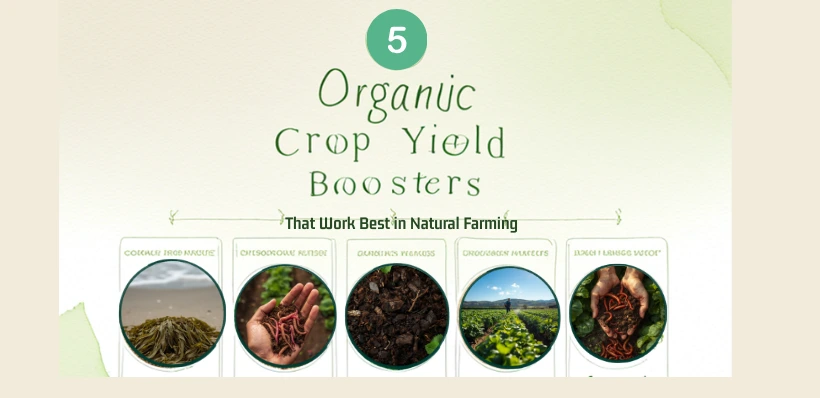
5 Organic Crop Yield Boosters That Work Best in Natural Farming
Agriculture is evolving rapidly as farmers move toward sustainable and eco-friendly practices. Natural farming has emerged as a powerful alternative to conventional methods that rely heavily on chemical fertilizers and pesticides. This approach focuses on improving soil health, preserving biodiversity, and ensuring long-term agricultural productivity.
One of the biggest challenges farmers face today is maintaining high crop yields while reducing chemical inputs. Overuse of synthetic fertilizers has degraded soil quality, reduced microbial activity, and made crops more dependent on external inputs. As a result, many farmers are now turning to natural solutions that restore soil fertility and improve crop performance.
Among these solutions, organic crop yield boosters have gained significant attention for their ability to enhance plant growth and increase productivity naturally. These inputs work by improving soil structure, increasing nutrient availability, and supporting beneficial microorganisms.
Natural farming is not just about avoiding chemicals; it is about building a balanced ecosystem where soil, plants, and microorganisms work together. By adopting the right techniques and inputs, farmers can achieve sustainable growth and better crop outcomes.
Organic crop yield boosters are natural agricultural inputs that improve plant growth, increase nutrient availability, and enhance soil fertility without the use of synthetic chemicals. These inputs support biological processes in the soil, leading to healthier crops and improved productivity.
Farmers use a combination of compost, microbial fertilizers, plant extracts, and biological enhancers to maintain soil health. Many of these inputs are also considered soil fertility boosters organic because they improve soil ecosystems while promoting sustainable farming practices.
Natural farming systems rely heavily on these inputs to maintain productivity while reducing environmental impact.
- Organic inputs improve crop yield naturally
- Healthy soil leads to better plant growth
- Microbial activity enhances nutrient availability
- Natural farming reduces chemical dependency
- Sustainable practices improve long-term productivity
Organic crop yield boosters are natural agricultural inputs that improve plant growth, increase nutrient availability, and enhance soil fertility without using chemical fertilizers.
These boosters include compost, biofertilizers, microbial formulations, and plant-based extracts. Instead of providing quick nutrients like chemical fertilizers, they improve soil health and support long-term productivity.
Farmers often combine these inputs with organic fertilizers for farmers to achieve balanced nutrition and better crop performance.
What Are Organic Crop Yield Boosters?
Organic crop yield boosters are natural substances used to improve crop productivity by enhancing soil health and nutrient availability. These inputs work by strengthening soil biology and improving the efficiency of nutrient absorption.
Unlike chemical fertilizers, which may provide immediate results but harm soil over time, organic solutions support long-term agricultural sustainability. They improve soil structure, increase organic matter, and promote microbial activity.
Many natural inputs used in farming are also classified as soil fertility boosters organic because they enhance soil ecosystems and improve nutrient cycling. These inputs create a healthy environment where plants can grow more efficiently.
Examples include compost, vermicompost, biofertilizers, seaweed extracts, and microbial enhancers.
Why Natural Farming Needs Yield Boosters
Natural farming focuses on maintaining soil health and reducing chemical inputs. However, soil often becomes depleted due to continuous cropping and environmental stress.
Without proper soil management, farmers may face several challenges:
- Reduced soil fertility
- Weak plant growth
- Lower crop productivity
- Increased pest attacks
To overcome these issues, farmers rely on natural inputs that improve soil structure and nutrient availability.
Using organic fertilizers for farmers helps restore soil nutrients and supports plant growth. These fertilizers release nutrients gradually and improve soil organic matter.
Natural farming also depends on improving soil biology. Beneficial microorganisms play a key role in nutrient cycling and plant development.
5 Organic Crop Yield Boosters That Work Best
1. Compost
Compost is one of the most widely used natural fertilizers in agriculture. It is produced by decomposing organic materials such as crop residues, animal waste, and kitchen waste.
Compost improves soil structure, increases organic matter, and supports microbial activity. It provides a steady supply of nutrients that plants can absorb over time.
Farmers often use compost as a base input in natural farming systems because it enhances soil fertility and improves water retention.
2. Biofertilizers
Biofertilizers are living microorganisms that improve nutrient availability in soil. These microbes help convert nutrients into forms that plants can absorb.
Common biofertilizers include Rhizobium, Azotobacter, and Mycorrhiza. These organisms play a key role in nitrogen fixation and phosphorus solubilization.
Many farmers combine biofertilizers with organic fertilizers for farmers to improve soil fertility and increase crop productivity.
Biofertilizers also help improve soil microbial diversity, which is essential for long-term soil health.
3. Seaweed Extracts
Seaweed extracts are natural plant growth stimulants derived from marine algae. They contain essential nutrients, vitamins, and plant hormones that support plant development.
These extracts improve plant metabolism, enhance stress tolerance, and increase crop yield. They are especially useful in conditions where crops face environmental stress such as drought or heat.
Seaweed extracts are widely used in natural farming systems to improve crop performance naturally.
4. Natural Soil Conditioners
Soil conditioners are used to improve soil structure and increase organic matter content. They enhance soil aeration and water retention, which are essential for plant growth.
Farmers use natural farming soil conditioners to restore degraded soil and improve nutrient absorption. These conditioners help maintain soil balance and support root development.
Healthy soil structure ensures that plants can access nutrients and water more efficiently.
5. Microbial Soil Enhancers
Microbial soil enhancers contain beneficial bacteria and fungi that improve soil biological activity. These microorganisms break down organic matter and release nutrients for plant growth.
Farmers use these inputs as organic crop yield boosters because they enhance nutrient cycling and improve plant health.
Microbial enhancers also help maintain soil biodiversity, which is essential for sustainable farming.
How Organic Boosters Improve Crop Yield
Organic inputs improve crop productivity through several key processes.
Improved Soil Structure
Organic matter improves soil texture and allows better root growth.
Enhanced Nutrient Availability
Microorganisms convert nutrients into plant-available forms.
Increased Water Retention
Healthy soil retains moisture, reducing water stress.
Stronger Plant Growth
Balanced nutrition leads to healthier crops and better yields.
Farmers using organic crop yield boosters often experience improved productivity and long-term soil health.
Benefits of Organic Crop Yield Boosters
Organic farming inputs offer several advantages for farmers.
- Improve soil fertility
- Reduce dependency on chemicals
- Enhance crop quality
- Support environmental sustainability
- Increase long-term productivity
Many farmers also use natural farming soil conditioners to maintain soil health and improve crop performance.
Statistics Section
Natural farming is gaining popularity worldwide due to increasing awareness about sustainability.
- Demand for organic produce is rising
- Farmers are reducing chemical usage
- Governments are promoting eco-friendly agriculture
- Soil health awareness is increasing
These trends highlight the importance of natural inputs in modern farming.
Table: Organic Crop Yield Boosters
Booster | Example | Benefit |
Compost | Organic waste compost | Improves soil fertility |
Biofertilizer | Rhizobium | Nitrogen fixation |
Seaweed Extract | Marine algae | Plant growth stimulation |
Soil Conditioner | Organic blends | Improved soil structure |
Microbial Enhancer | Beneficial microbes | Nutrient cycling |
- What are organic crop yield boosters?
Organic crop yield boosters are natural inputs that improve plant growth and increase crop productivity without chemical fertilizers.
- How do natural inputs improve crop yield?
Natural inputs improve soil health, increase nutrient availability, and support microbial activity, leading to better plant growth.
- Which organic input is best for farming?
Compost, biofertilizers, and microbial enhancers are among the best inputs for improving crop yield.
Conclusion
Natural farming is the future of sustainable agriculture. It focuses on improving soil health, reducing chemical dependency, and ensuring long-term productivity.
By adopting compost, biofertilizers, microbial enhancers, and other natural inputs, farmers can improve crop yield while protecting the environment.
The use of organic crop yield boosters plays a crucial role in building resilient farming systems that support sustainable agriculture.
Farmers who invest in soil health today will benefit from better productivity and long-term success in the future.
FAQs
- What are organic crop yield boosters?
- Organic crop yield boosters are natural agricultural inputs that improve plant growth, enhance soil fertility, and increase crop productivity without using synthetic chemicals.
- How do organic inputs improve crop yield?
- Organic inputs improve crop yield by enhancing soil structure, increasing nutrient availability, and supporting beneficial microorganisms that help plants grow efficiently.
- Which organic fertilizer is best for farmers?
- Compost, vermicompost, and biofertilizers are among the best organic fertilizers because they improve soil health and provide balanced nutrients for crops.
- Are organic fertilizers safe for the environment?
- Yes, organic fertilizers are environmentally friendly because they reduce chemical pollution, improve soil biodiversity, and support sustainable farming practices.
- Can organic farming maintain high crop productivity?
- Yes, organic farming can maintain high productivity when farmers use proper soil management techniques and natural inputs that support soil fertility.
- What role do microorganisms play in soil fertility?
- Microorganisms break down organic matter and convert nutrients into forms that plants can absorb, improving soil fertility and plant growth.
- What are natural soil conditioners in farming?
- Natural soil conditioners improve soil structure, increase water retention, and enhance root development, making soil more suitable for crop growth.
- How often should farmers use organic fertilizers?
- Farmers should apply organic fertilizers during soil preparation and early growth stages, depending on crop type and soil condition.
- Why is soil health important in natural farming?
- Soil health is essential because it supports plant growth, improves nutrient availability, conserves water, and ensures long-term agricultural sustainability.
Not Sure Which Product Is Right for Your Crop?
Our agriculture experts are ready to help you choose the best organic solution.